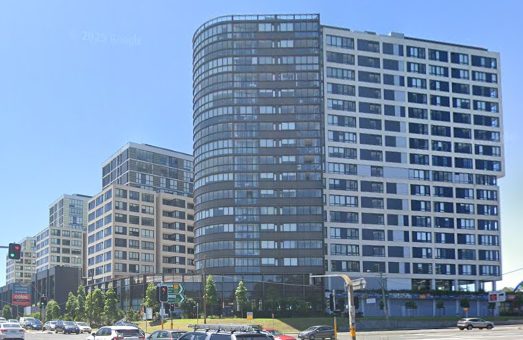
Gladesville Master Plan
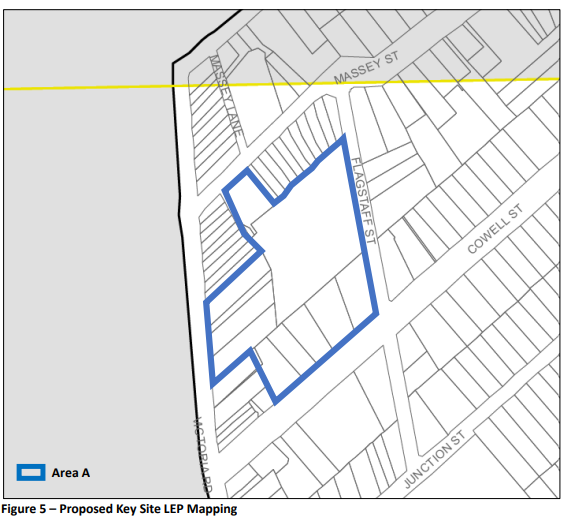
What is being proposed?
Many people have come to me asking what council is actually proposing in the Gateway process currently being assessed by the Department of Planning, Housing and Infrastructure. Given the planning report was 400 pages in April 2025, and 500 pages in February 2026, I can appreciate that this may not be easy to find. What Council is proposing is currently, ‘indicative drafting’ (still) of a single paragraph to be inserted in the LEP, which reads:
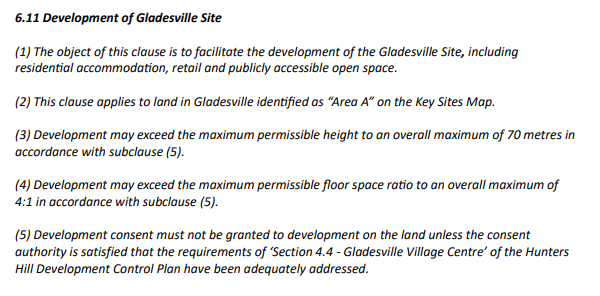
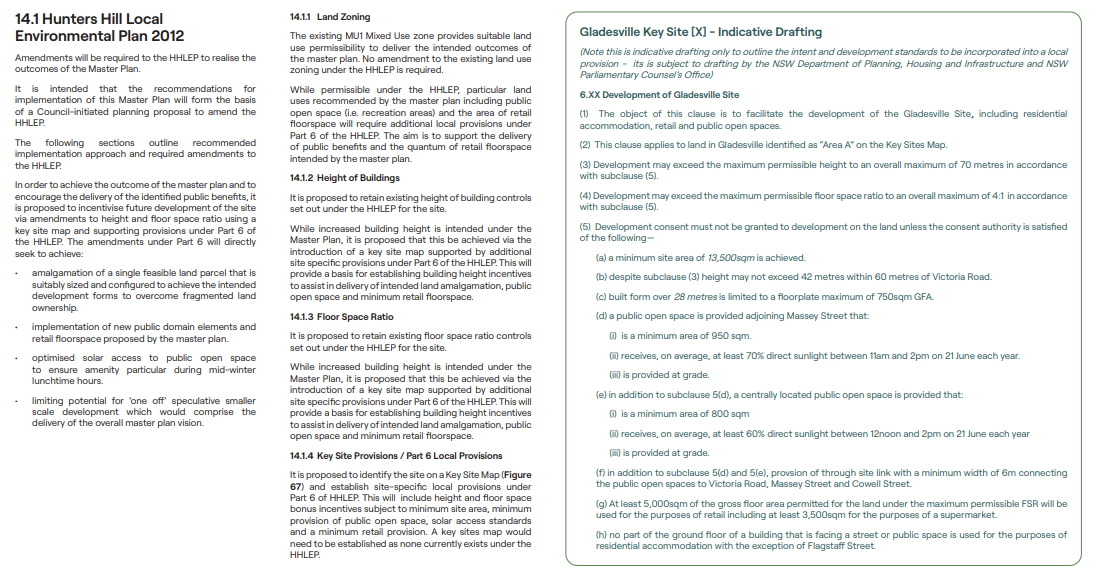
You’ll note this is quite more abridged than the previous version which proposed, at least, the benefit of public open space in the block - in accordance with Gyde’s own report “Implementation” section, below. Note the heavy reliance on ‘adequately addressing’ the DCP now, which starts on p411 of the February 2026 Agenda.
Now we all want to see Gladesville town centre improved. That’s why council did a master plan in 2021 and voted to pursue it further after ‘testing lower height options’.
What we are doing in 2026 is not what was approved in 2021 - it is a site-specific scheme, and one that risks poor outcomes - some (like sterilising the remaining sites in the town centre, or overshadowing Gladesville Public School) our reports already show will occur. Moreover what concerns me is that the whole reason we are doing a master plan is, according to the presentation on 25 March, to get public benefit that previous developer schemes did not - namely open space. Now I could argue that the open space areas are small and overshadowed but my bigger concern is that the rezoning the subject of the Gateway process does not protect this outcome - it only increases height and FSR. The general clause 6.11(5) is so vague as to risk being entirely unenforceable - and even if it is enforced, the specific outcome of open space of a certain size and sunlight is not clearly and unambigously protected.
Now councils also must apply DCPs flexibly and allow for reasonable alternative solutions (since 2012) - so by removing clauses from the LEP we reduce protection of these things. In fact, the DCP is so wordy that it’s difficult to know what 6.11(5) protects - something the Land and Environment Court would be pressed to enforce. In professional terms I would call this “sloppy drafting”. This is especially since public open space is not mandated in the DCP, it is just an ‘opportunity’. In fact, the summary report clarifies that public open space will not be mandated, only ‘publicly accessible open space’, while the DCP seeks only a minimum width of 6m and an overall area of about 4000sqm (see below). It is not even clear from the drafting or report if these outcomes are what is ‘measurable’ for compliance with 6.11(5) - such is the drafting - so all we are really ‘securing’ is a minimum amount of retail, in exchange for height and FSR.
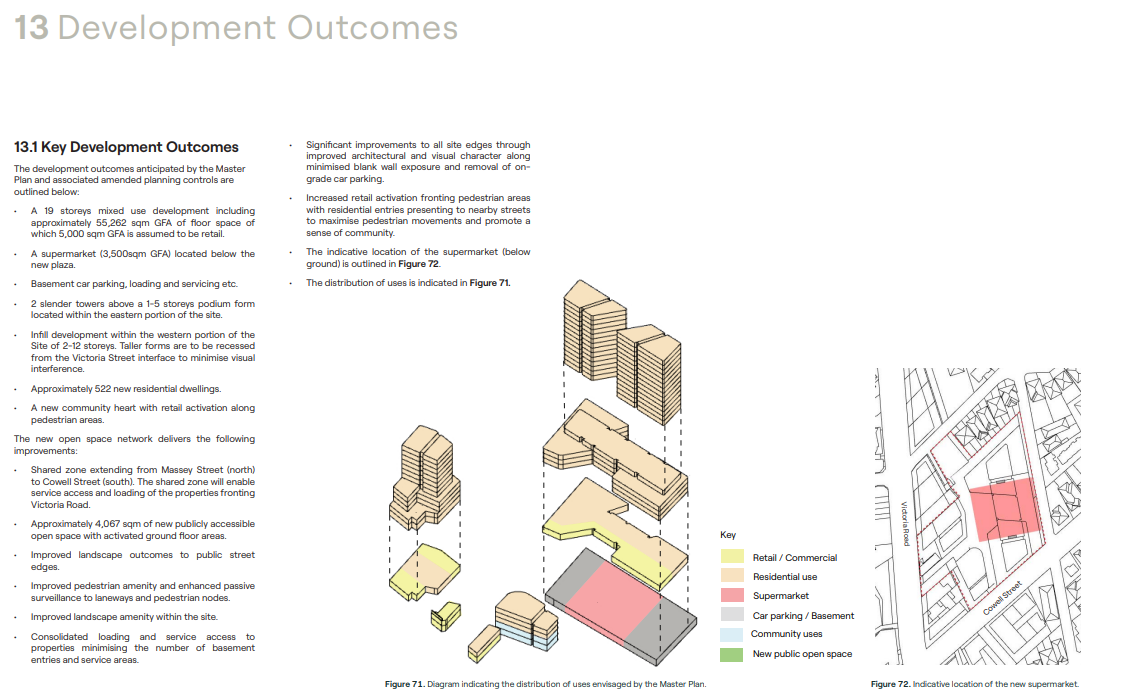
Let’s say Section 13 is the key clause for the sake of s6.11(5) of the LEP. Even then, what is it council is trying to protect? Not 19 storeys given the LEP allows 70m (22-23 storeys, +30% with an affordable housing bonus under the Housing SEPP, so up to 30 storeys) which overrides the DCP.
Is it 2 slender towers? Would we therefore reject 10 storey street wall buildings of the same FSR? Even though that’s what the community asked for (a lower height option). Would we reject 3 towers? Is the open space ‘network’? Does it need to be a min size, or not be overshadowed?
Moreover what is ‘increased retail activation fronting pedestrian areas’ and ‘significant improvement of all site edges’ given only Victoria Road is active edge in the DCP? Is it okay if all the parking and loading are along Flagstaff St?
What about the buildings north and south that load off the existing laneway through the site?
But of course it might not be s13 that the LEP refers to, since even that is not clear. It could be the three ‘principles’ of ‘green’, ‘connected’ etc. And if so, anything goes…
A biggest question, of course, is cui bonum - who benefits from the massive uplift (assuming the construction and oil crises don’t mean we have rendered the site overcooked)? Because if council hasn’t really secured any material benefit for the community, why is council pursuing a site-specific rezoning?
Still, it is highly unlikely that this council is likely to drop the rezoning entirely, since we could achieve these outcomes with just a DCP change - there is still an opportunity to pursue a lower height option (with the same FSR) and to ensure that the development delivers the public benefit we need.
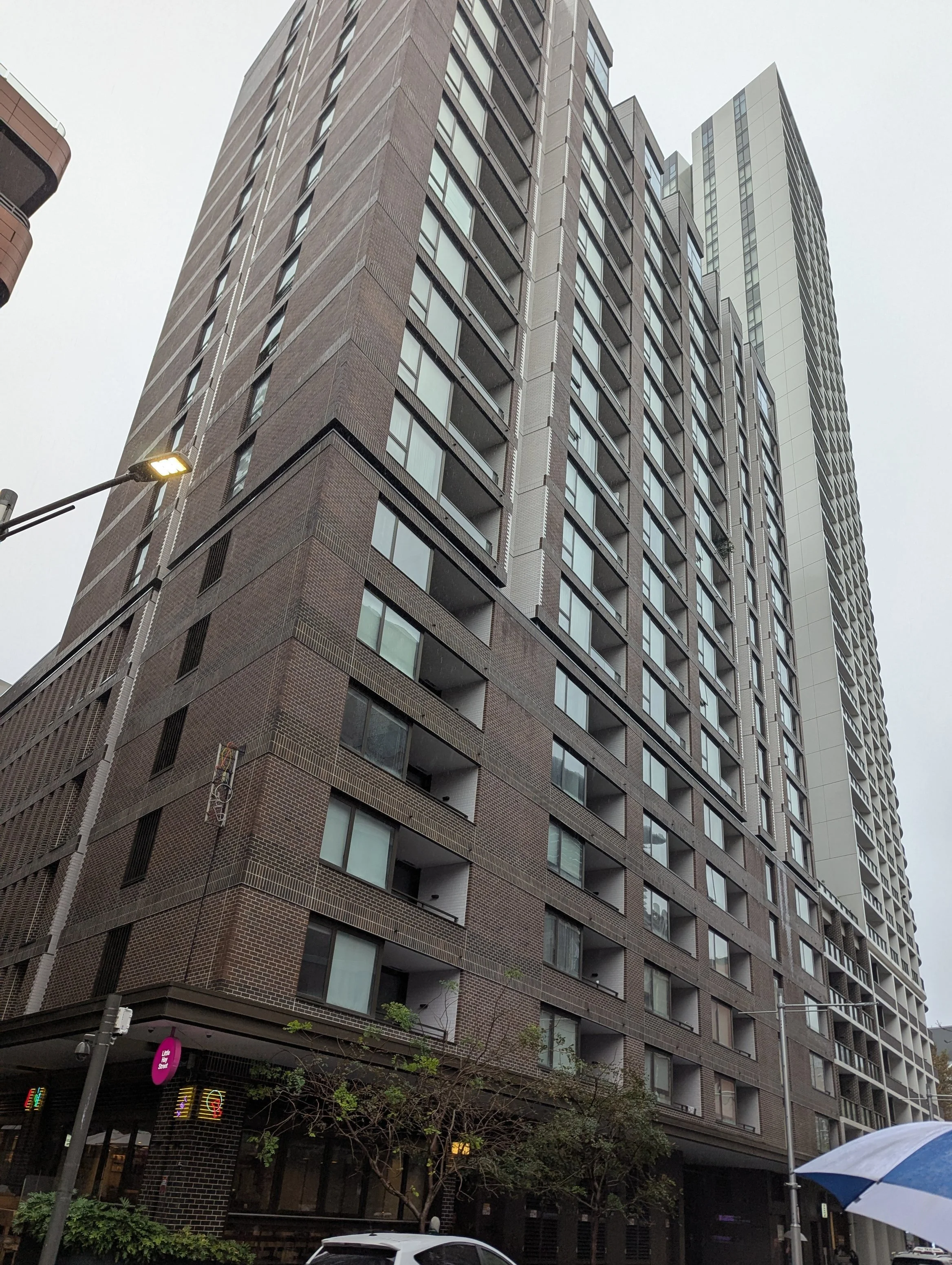
83 Harbour Street, Haymarket
A 19 storey building within a rigorous area master plan and design excellence planning environment.
What was proposed in April 2025?
Then, the key operative clause being considered for inclusion in the Local Environmental Plan (LEP), be found in item 4.2, page 25 of Council’s Meeting Agenda for April 2025. https://huntershill.infocouncil.biz/Open/2025/04/OC_20250428_AGN_3101_AT.PDF was:
Key Site Provisions / Part 6 Local Provisions
It is proposed to identify the Site on a Key Site Map and establish site-specific local provisions under Part 6 of LEP. This will include height and floor space ratio bonus incentives subject to minimum site area, minimum provision of public open space, solar access standards and a minimum retail provision. A key sites map would need to be established as none currently exists under the LEP. Indicative drafting of the proposed LEP amendment is outlined below. It can be noted that the purpose of this indicative drafting is to outline the intent and development standards to be incorporated into a local provision. This proposed amendment would be subject to final drafting as part of the planning proposal process.
6.11 Development of Gladesville Site
(1) The object of this clause is to facilitate the development of the Gladesville Site, including residential accommodation, retail and public open spaces.
(2) This clause applies to land in Gladesville identified as “Area A” on the Key Sites Map.
(3) Development may exceed the maximum permissible height to an overall maximum of 70 metres in accordance with subclause (5).
(4) Development may exceed the maximum permissible floor space ratio to an overall maximum of 4 :1 in accordance with subclause (5).
(5) Development consent must not be granted to development on the land unless the consent authority is satisfied of the following—
(a) a minimum site area of 13,500sqm is achieved.
(b) despite subclause (3), height may not exceed 42 metres within 60 metres of Victoria Road.
(c) built form over 28 metres is limited to a floorplate maximum of 750 square metres of gross floor area.
(d) A public open space is provided adjoining Massey Street that:
(i) is a minimum area of 950 square metres.
(ii) receives, on average, at least 70% direct sunlight between 11am and 2pm on 21 June each year.
(iii) is provided at grade.
(e) In addition to subclause 5(d), a centrally located public open space is provided that:
(i) is a minimum area of 800 square metres.
(ii) receives, on average, at least 60% direct sunlight between 12noon and 2pm on 21 June each year.
(iii) is provided at grade.
(f) In addition to subclause 5(d) and 5(e), provision of through site with a minimum width of 6 metres connecting the public open spaces to Victoria Road, Massey Street and Cowell Street.
(g) At least 5,000 square metres of the gross floor area permitted for the land under the maximum permissible floor space ratio will be used for the purposes of retail, including at least 3,500 square metres for the purposes of a supermarket.
(h) No part of the ground floor of a building that is facing a street or public space is used for the purposes of residential accommodation with the exception of Flagstaff Street.
What has been my position?
I opposed the motion to submit this for gateway on the basis that it is not ready, and should go on public exhibition first, in a format that people could understand. All the speakers to this item raised one flaw or another with the current proposal, including the majority site owner’s representative. I will elaborate on the many ways the proposal could be improved, but in summary the issues I raised in that meeting included:
considerable departure from the 2021 scheme exhibited to the public, increasing the FSR by 25% and significantly more height. A rule of thumb in planning is that >10% is a new scheme. Additionally, council resolved in 2021 that the scheme should proceed provideda lower height option was investigated. Instead, council has onlyinvestigated a higher option
no new traffic or transport study was prepared, despite the proposal being 25% larger than that exhibited in 2021.
The feasibility assessment is flawed. This is not HillPDA’s fault, but overestimation of the car parking requirements by Bitzios amounting to 950 spaces (not 700 spaces) being proposed. This inflates the cost of construction considerably, by about $18m, which in turn affects feasibility by up to 3% (in other words, a developer profit of 18% in the HillPDA report would be 21% with the correct parking rate). Also:
the feasibility assessment specifically excludes assessment of affordable housing, even though developers can access a 30% height and FSR bonus if they include affordable housing. In other words, A scheme of 5.2:1 FSR (height of 91m) is permissible with affordable housing. Worse yet, by making the scheme feasible at market rates (the HillPDA report explicitly relies on price increases for housing), we have ‘nudged’ the developer away from using affordable housing in feasibility, towards (premium) market housing.
the worked example by HillPDA uses ‘medium rise’ (that is, roughly 10 storey) cost calculations in their work - in fact the scheme has been developed as ‘high rise’, which has a higher cost base in HillPDA’s own assumptions. This makes it less feasible in tower form.
the developer’s representative also flagged potential challenges to feasibility as a result of mandatory amalgamation. If this is foisted on the developer, nothing may happen at all - and these height and FSR controls will inflate the cost of land for the next purchaser, sterilising the land in the longer term. Gosford CBD is a good example of sterilisation when you overcook controls.
While the indicative scheme shows 19 stories and minimises overshadowing to the surrounds, none of this is mandated. Plenty of other schemes are possible. A DCP (which hasn’t been prepared) will not fix this, it is a guide only. The scheme also doesn’t require a lane through the site to be kept / made for rear access of the adjacent blocks and pedestrian/cycle access - nor activation of the surrounding streets. While there is a provision for connecting to each of the surrounding streets and public open spaces (about half of the 4000sqm indicated is actually protected) - this could be realised in a number of ways which make moving through the site difficult, and turns the remaining 'ground’ floor into common space for the occupants only.
We do not have a contributions plan in place for Gladesville. We don’t even have a social infrastructure and open space study. Therefore council has an unknown liability to support this density in the future, and no basis for negotiation of the developer contribution other than our ‘gut feel’. A ‘no regrets’ approach would advance the s7.11 contributions plan to a point we knew what council’s liabilities were first.
What did I propose in February 2026?
Because the scheme came back still deficient (in fact worse in terms of public benefit), I proposed in the February meeting that some basic matters be addressed, below. This was lost. Among the Liberal block, there appears to be more interest in getting ‘anything’ done about Gladesville (noting that we all agree a plan for improving the current town centre is important) - than there is to ensure that the something that comes is better than what is there now.
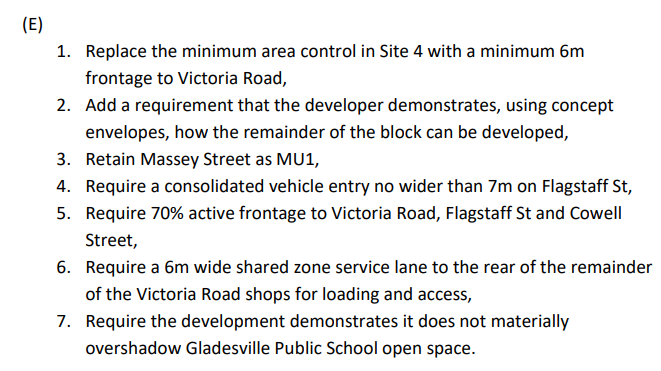
Having done site testing myself, I am confident not only that a better, lower height option is possible, but that a more rounded scheme could be developed, co-designed with the community.
There remains an opportunity during this public exhibition of the Gateway scheme to fix the scheme, even if this potentially requires re-submission to DPHI. The community’s voice on this will be instrumental in determining what happens going forward.
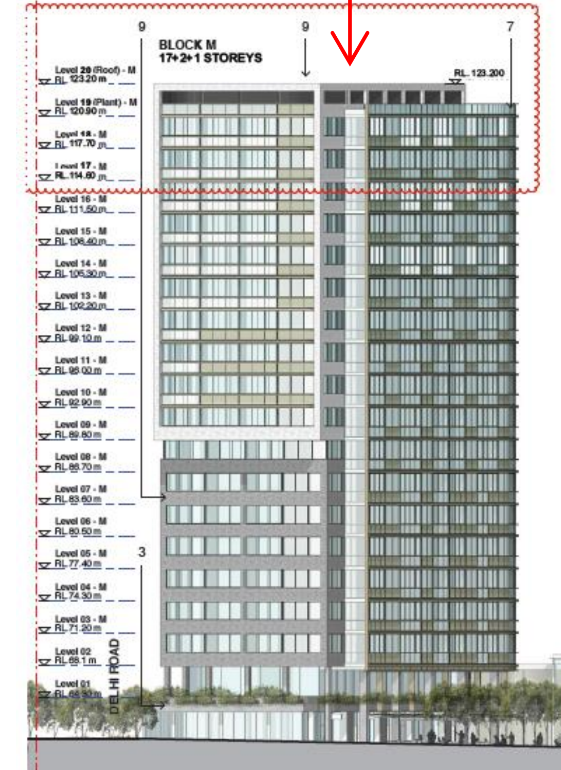
Block M, Lachlan’s Line, Lane Cove
Down the road from Hunters Hill, this is a good comparable 20 storey 63m high residential building as part of a multi-unit + shopping centre development with similar ‘flexibility’ given.
Block M from Epping Rd, in the foreground below.