

Council Land Sales: What You Need to Know
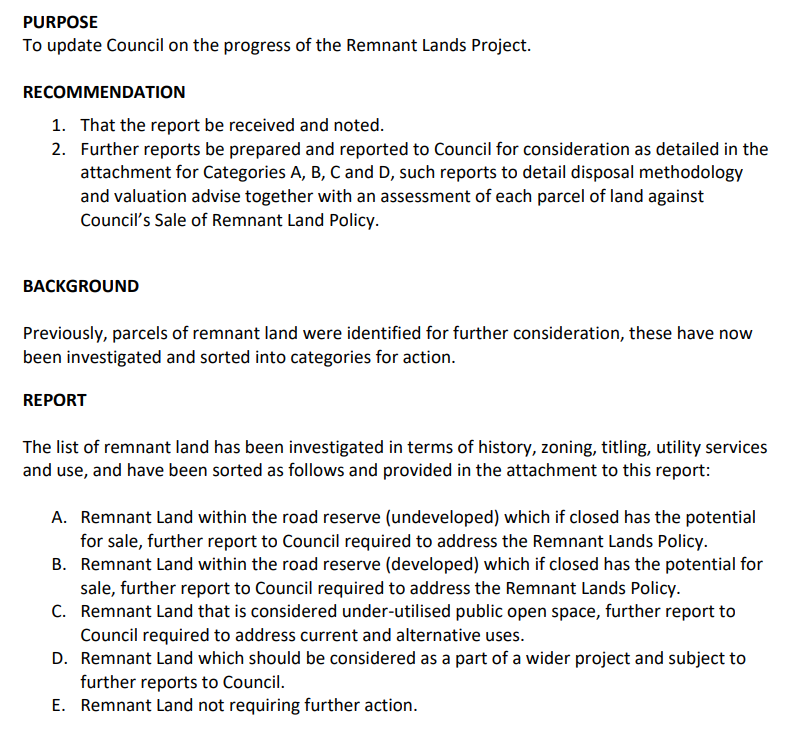
In August, your Council began the process of evaluating and potentially selling several parcels of Council-owned land (termed ‘remnant land’ is used the motion and in the classification of land as ‘REM’), although the motion precedes (and thus presupposes) the classification of those parcels as such, which is required under the Sale of Remnant Land Policy. The exact motion is at right, which requires reports ‘to detail disposal methodology and valuation advise together with an assessment of each parcel of land against Council’s Sale of Remnant Land Policy’. Note from this wording and order that disposal is also presupposed. It can be found here (item 4.2), together with the list of properties for investigation.
I'm writing to cut through the complexity and explain why this matters to you, and how you can have your say before any final decision is made.
Councillors Williams and I have set out our expectations of how this process will occur and the relevant NSW Government guidance that should be followed. This was set out in a motion seeking to improve Council’s process around sale of land, which can be read here (at 3.1) and at the bottom of this page.
This motion was lost by the vote of the Liberal majority.
The Big Picture: Why This Is a Concern
Council may sell these lots before we have a crucial piece of information: a Social Infrastructure and Open Space Needs Analysis:
Why we need this study NOW:
Massive Future Growth: The NSW Government's new low-medium rise (LMR) reforms are set to significantly increase our local population, potentially doubling the number of homes in areas like Boronia Park and Gladesville.
More People Need More Parks: More residents mean a far greater need for open space, sports fields, and playgrounds—especially in areas that currently don't have enough within walking distance.
The Land Grab Risk: Selling land now, before we know what we need, risks selling a key piece of property that will be vital for a new park or playground for future families. I am pushing for the Needs Analysis to be completed before any major land sale decisions are made.
What Is "Remnant Land"? (Simplified)
The Council motion is about what we call "remnant land."
The Simple Idea: It's supposed to be small, leftover pieces of land (e.g., awkward corners or unused verges) that are considered surplus to our needs.
The Problem: Many of the lots currently listed are not clearly "leftovers." Some are valuable open space that residents currently use.
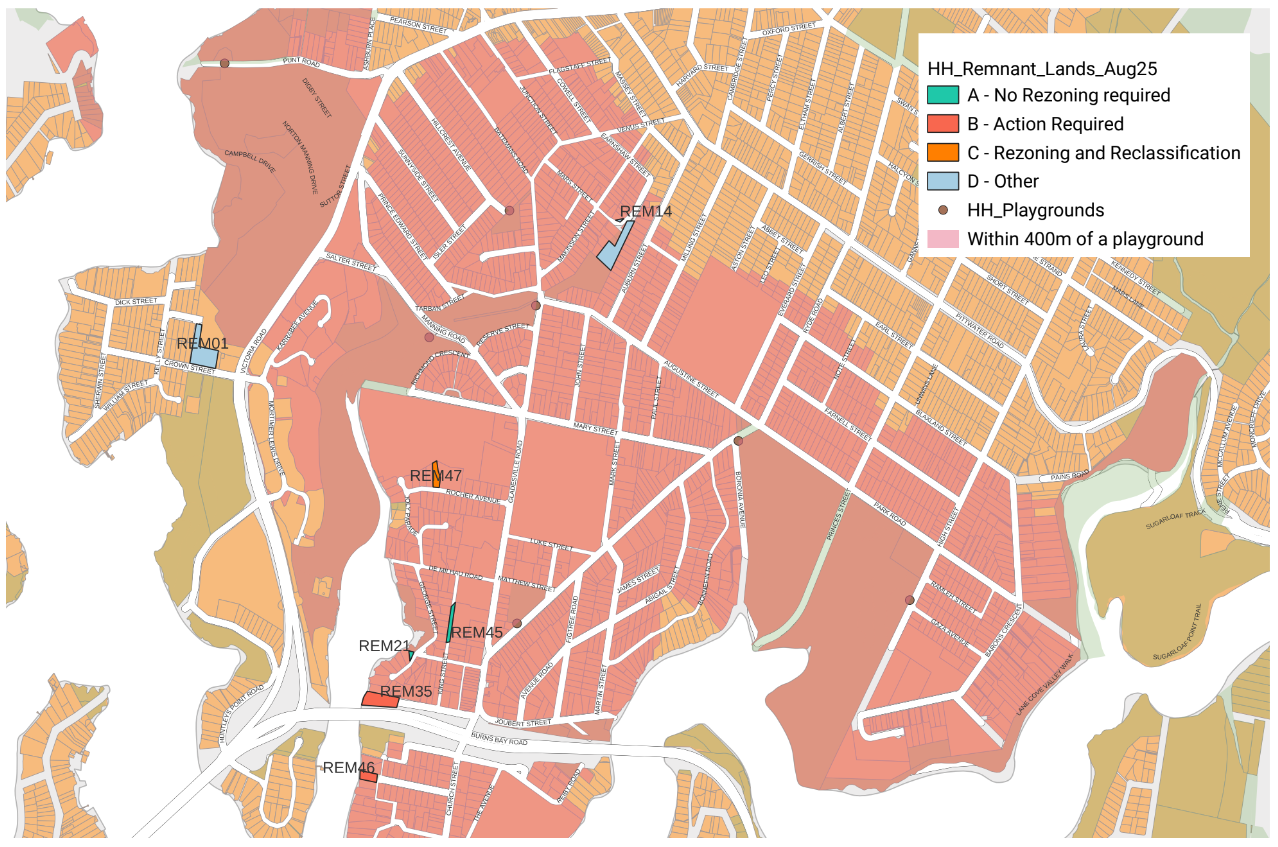
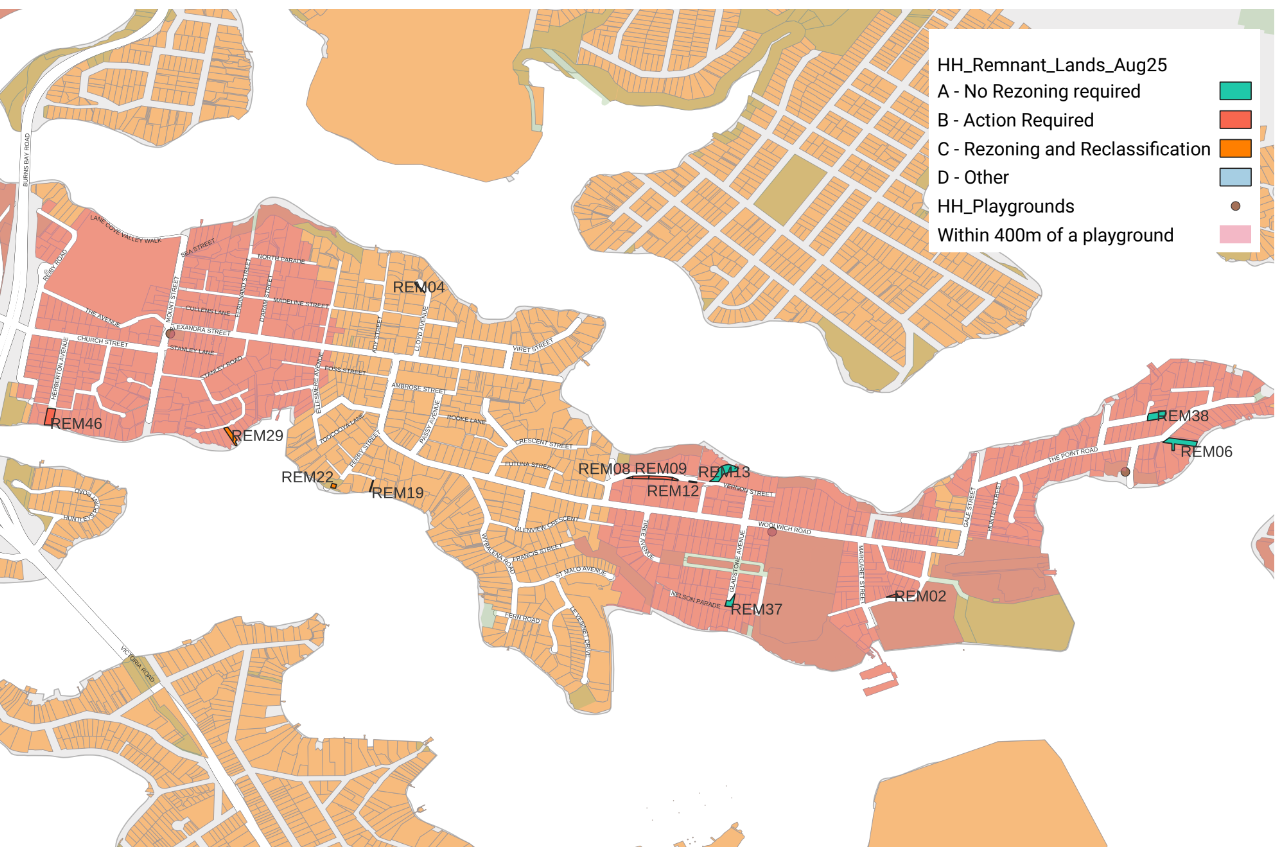
A Past Example: A previous proposed sale on Vernon Street was stopped because residents identified an unrecorded public access easement (right of access connecting the site to Mornington Reserve) that Council staff had missed. Now, a similar lot (REM13 on Serpentine Road) is listed, raising the same concerns—it sits next to a larger, accessible public open space.
The Land Parcels Being Assessed
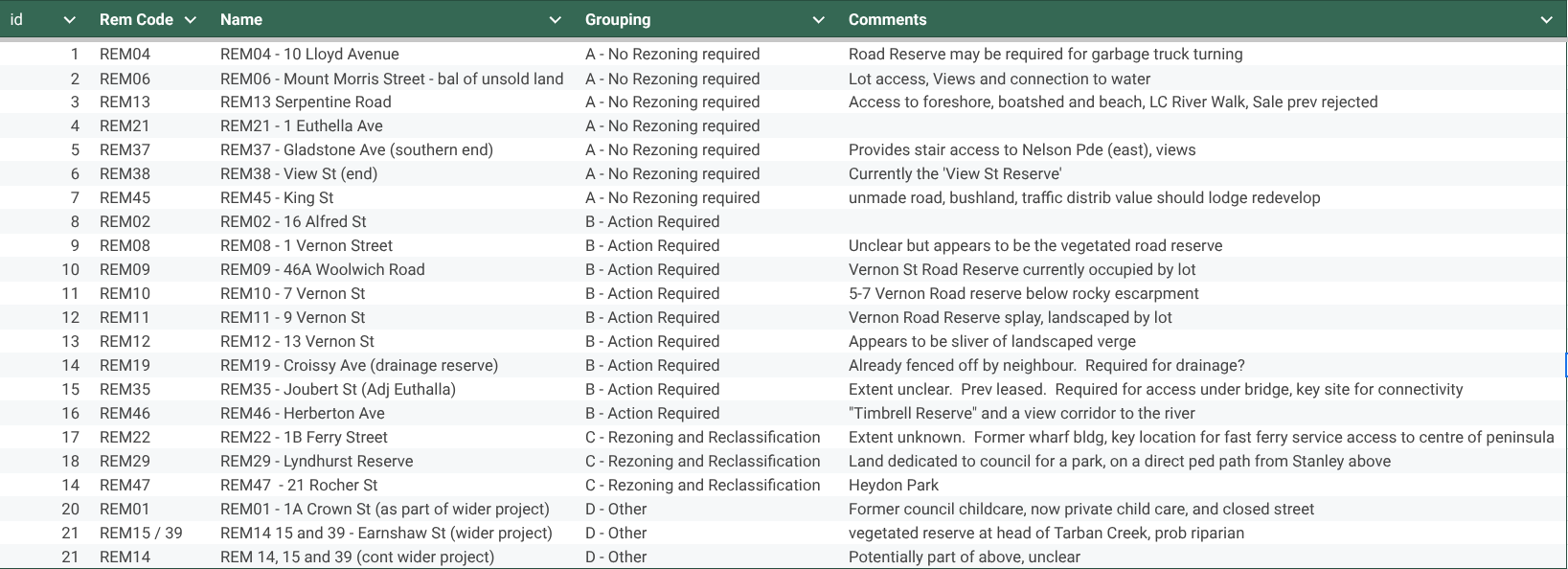
Council has listed several parcels, identified by a 'REM' number. Crucially, the decision to declare the land "remnant" and the approval to sell it are being combined into a single vote.
Because Council's official Land Register and maps are outdated (the register is over three years old, and clear maps for these lots were not provided in the meeting papers), I have had to create my own 'best efforts' map to show their potential locations.
I encourage you to look at the list and any associated maps provided by Council (when they are released) and share your specific feedback on any parcel you know well
Criteria - Disposal of Council Land Policy
3.1.1. Whether the land is necessary to provide current or future services of the Council or meet operational needs;
3.1.2. Whether the land is currently used or required for use in the future for community or public recreation purposes;
3.1.3. Whether disposal of the land would have an unreasonable adverse effect on the amenity or facilities available to the local community;
3.1.4. Whether the funds generated will provide a greater benefit to the community through the provision of new infrastructure.
3.1.5. Whether maintenance of the land is beyond Council’s reasonable financial capacity;
3.1.6. Whether there are statutory or other legal reasons that require the Council to maintain ownership of the land such as (but not limited to) actual or implied trusts that were established as a result of Council’s acquisition of the land;
3.1.7. Whether the land has cultural, natural or heritage value that should be maintained;
3.1.8. Whether the land is contaminated and, if so, whether it is possible and appropriate for responsibility for ongoing management and remediation of the land to be transferred;
3.1.9. The likely future use of the land if it is disposed;
3.1.10. Whether disposal of the land would create an access issue for adjoining land holders; and
3.1.11. Whether the cost to progress the disposal of the land is higher than the estimated value of the land.
3.1.12. Whether the reason for the disposal of the land would instead be better served via a lease (cost/time/value).
3.1.13. Whether there are Utility Authority Assets within the land which would make disposal unviable.
3.1.14. The history of how the land was acquired by or transferred to Council.
3.2. The list of matters in clause 3.1 is not exhaustive. Each parcel of land has its own circumstances that will need to be investigated and considered when making a determination as to whether the land has potential for disposal
Cllr Williams and Lane’s expectations
In the council meeting on 23 February 2026, Clls Williams and Lane set out their expectations of assessment under council’s policy as follows:
Relevant Considerations (Expectation)
Whether any open space or facility required that could be served by the lot. Reference Council’s Social Infrastructure Needs Assessment (once published).
As above. Using the lot size and Box 5.1 of the Framework for Valuation of Green Infrastructure and Public Spaces, NSW Government, (the Framework), consider whether any future purpose would be inhibited by the sale (for example, it would no longer be possible to provide a small park within 200m of some residents).
The change in residents within the catchment of the relevant lot that is public open space. (See Fig 5.3 of the Framework for Valuation of Green Infrastructure and Public Spaces, NSW Government, (the Framework, p28). For loss of space under 0.5ha (small open space), the stated catchment is 200m (p26). Not quality of the open space is not relevant
The specific use of the funds proposed, the quantified benefit to the community of that use, pro-rated to the contribution of this sale to the total cost of that use.
NET OF the detriment to the community as a result of the loss of public open space, by reference to the Framework. This includes -0.3% of the property prices of each resident listed in 3.1.3 above due to the loss of a small open space (see 5.1.1.1 of the Framework), the probably loss in canopy cover from construction on up to 50% of the site (permitted under LEP/DCP) for residential uses, the passive and non-use value of biodiversity and others - all as per the Framework, ob cit.
NB The quantified benefit must be materially greater than the detriment (net positive) to provide “greater benefit”.
The amount spent on the lot by council in the last 5 years
Council should have a register of these for reference - for example council as Trustee of the Hunters Hill Men & Boys Club Fund (with asset, Fairland Hall) is no longer on a public register, and is at risk of being forgotten. Implied trusts for the construction of other public facilities like the Hunters Hill Sailing Club are also not recorded. Council’s s53 Land Register is also significantly out of date.
A formal written assessment by council’s Heritage officer, and CAP if in a conservation area.
Including estimated costs.
NB Use extends beyond zoning and should set out height, bulk etc controls proposed
Estimated value of the land. Estimated cost to progress. This cannot be assessed without these estimates being obtained prior to the motion.
An assessment of the best mechanism for value capture from the betterment of making the land private. e.g. Leasehold, ‘leveraging government interest in land’
Councils s53 Land Register should display this information.
Any representations made by residents in respect of the relevant lot in the last 5 years. Some lots have previously been considered for sale (eg: Serpentine Road, 20y ago) and a discussion of why these previous efforts were abandoned should be clearly described.
First off the block - Gladesville Occasional Child Care Centre
Despite just negotiating a lease with Gladesville OCCC, Hunters Hill Council is now proposing to sell the land on which the OCCC operates - without a plan for replacing it.
Keep an eye out on Hunters Hill Council’s website for more details of the public exhibition.
Your Voice Matters: How to Get Involved
If you know any of these parcels—or if you simply agree that we should Pause and Plan by doing the Needs Analysis first—your input is essential.
Email Council | Write to info@huntershill.nsw.gov.au to share your reasons why a parcel should not be declared remnant or sold.
Email Me | Share your specific feedback on the parcels or your thoughts on the Needs Analysis with me directly.
Speak at a Meeting | You can formally apply to address the Council meeting (either at the item or during the public forum) when the lots come back for a final vote.